The long game
A finely tuned home on the hills in Ōtautahi Christchurch by Urbanfunction and Brad Richards Building was designed with longevity in mind.
WORDS Cassie Doherty PHOTOGRAPHY Stephen Entwisle
There’s a certain kind of pressure when an architect or designer creates their own home. There’s an expectation of perfection, that the result should be less a place for them to live and more an ultimate expression of their legacy.
For Aaron Jones, director and architectural designer at Urbanfunction, it was an opportunity for exploration. Of course his new home on the lower slopes of the hills above Sumner in Ōtautahi Christchurch is foremost a comfortable abode for him and seven- year-old cavoodle Kupe: a response to the site and his personal preferences and functional requirements. But he did also view the project as a lens through which to experience for himself the strategic thinking that underlines all Urbanfunction’s work.
Having designed the home and now living in it, it adds a layer of knowledge to these ideas, particularly around how spaces perform, how materials age and how a house adapts over time.
Of the many principles he was interested in, one of the most significant was longevity. “Good architecture should work hard, age well and still feel relevant long after trends pass,” he says. “The most sustainable building is the one you don’t need to redesign in 10 years.”
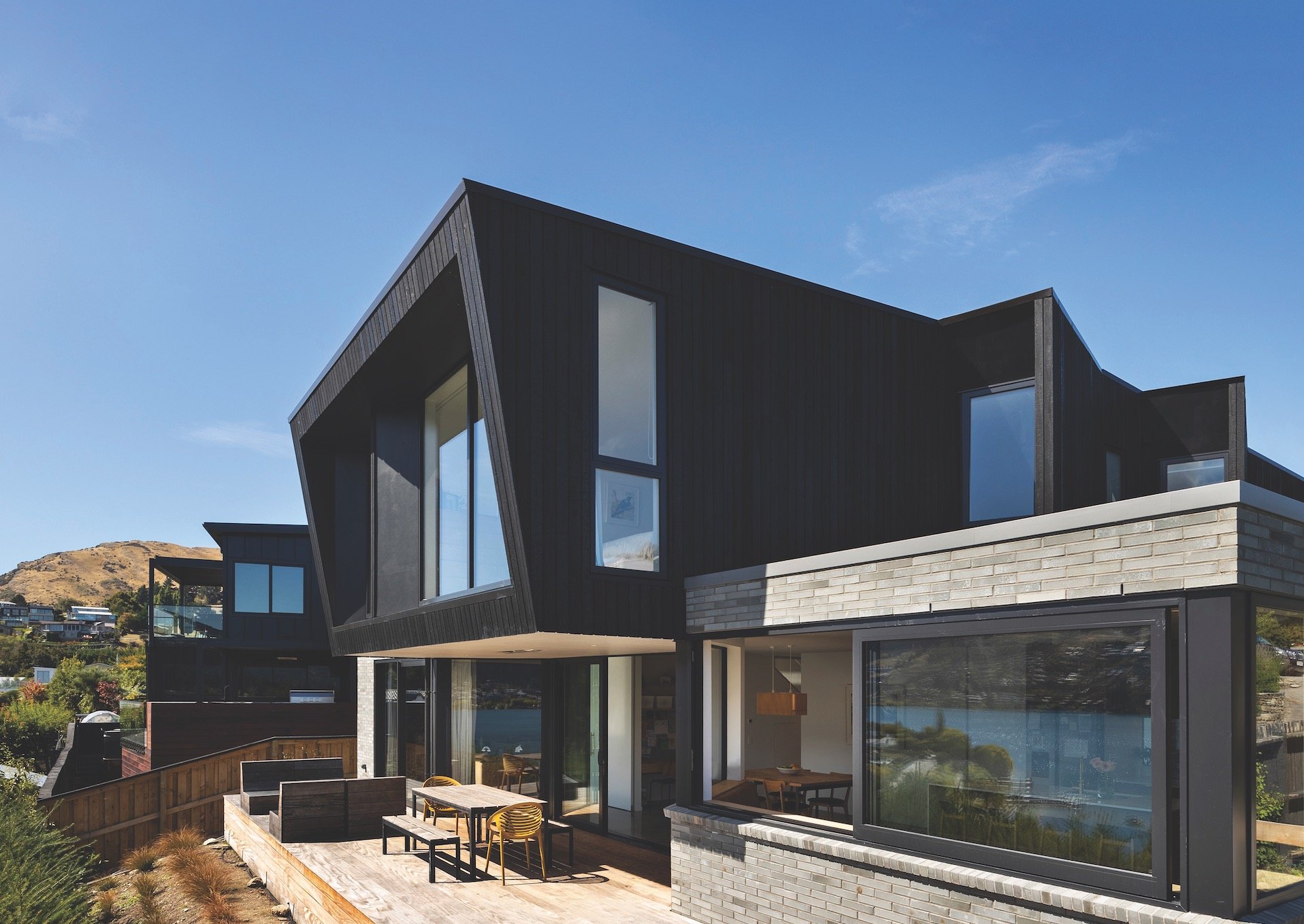
First, this means a plan that’s as adaptable as possible. The house has a tight 120sqm footprint. Through sectional planning, split levels and a carefully resolved roof form, the house expands spatially beyond its size while maintaining efficiency and performance. Living spaces project outward to capture panoramic views, while more private zones step back, creating a balance between openness and retreat. Compact planning increases efficiency without sacrificing spatial quality.
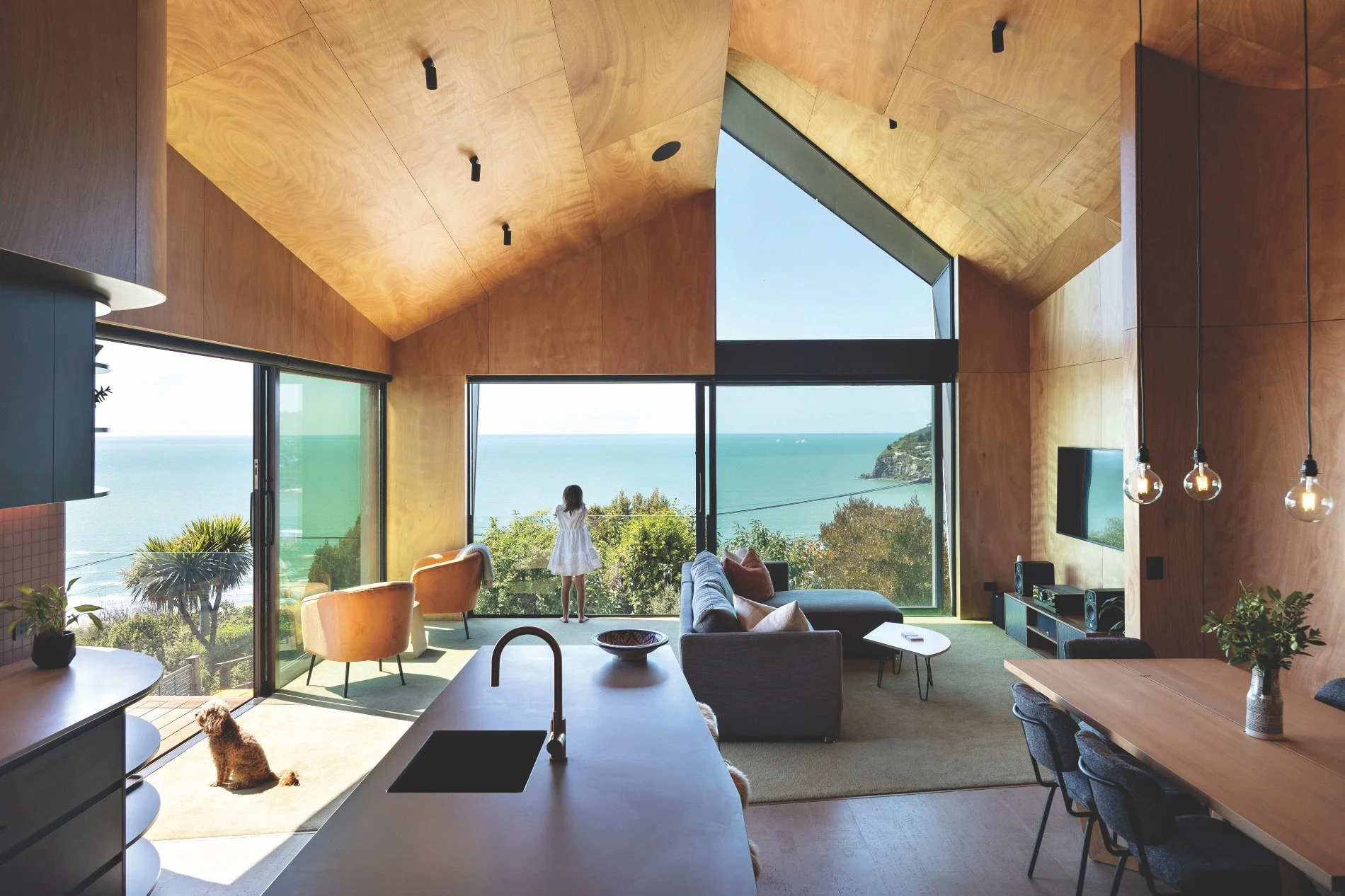
All windows and doors in this home were supplied by Rylock Canterbury; the recessed window system was utilised to keep the windows in the home’s thermal envelope.
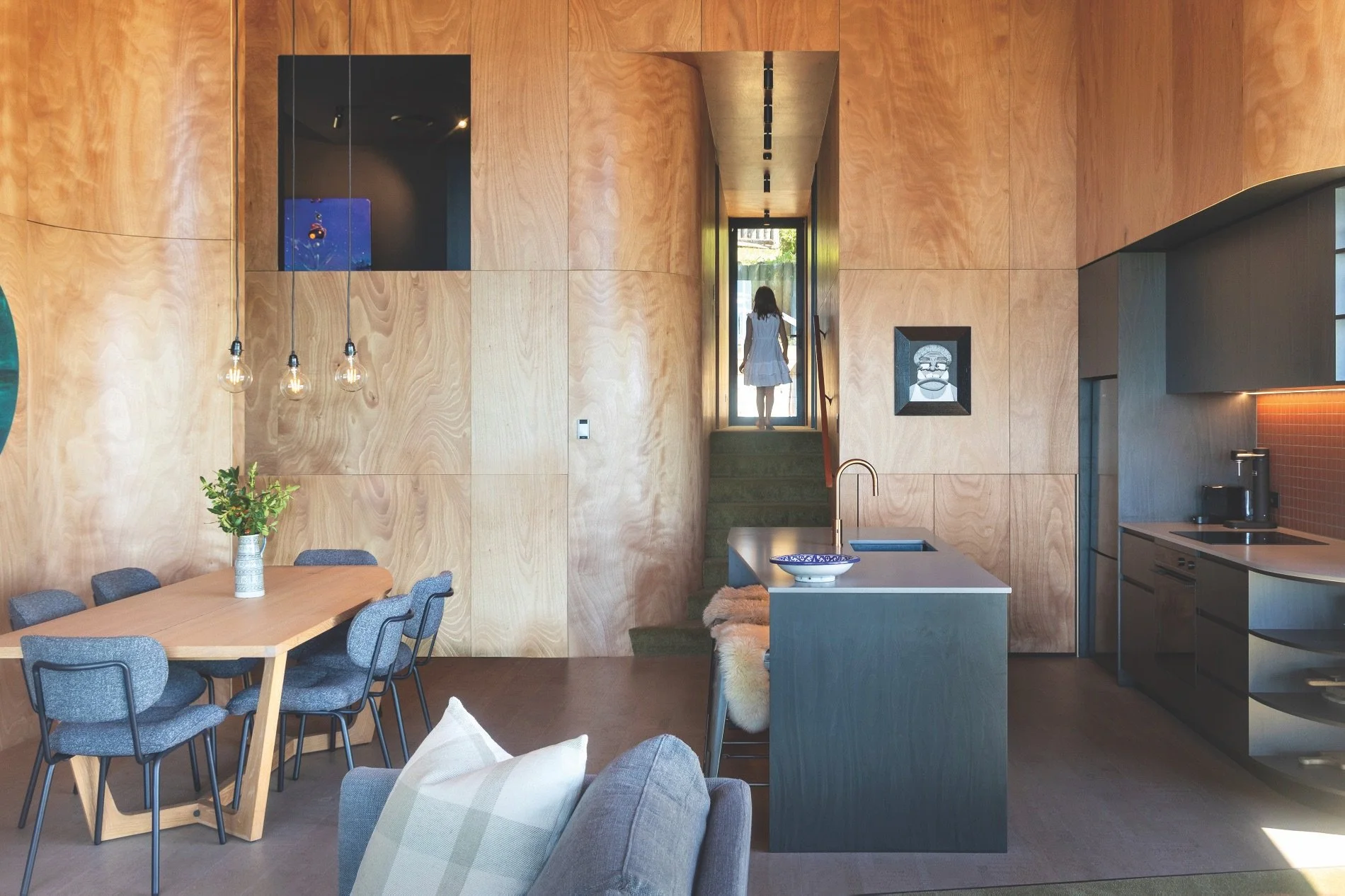
Plymasters RapidLine Okoume plywood defines the interior – adding warmth and complementing the architecture of the home.
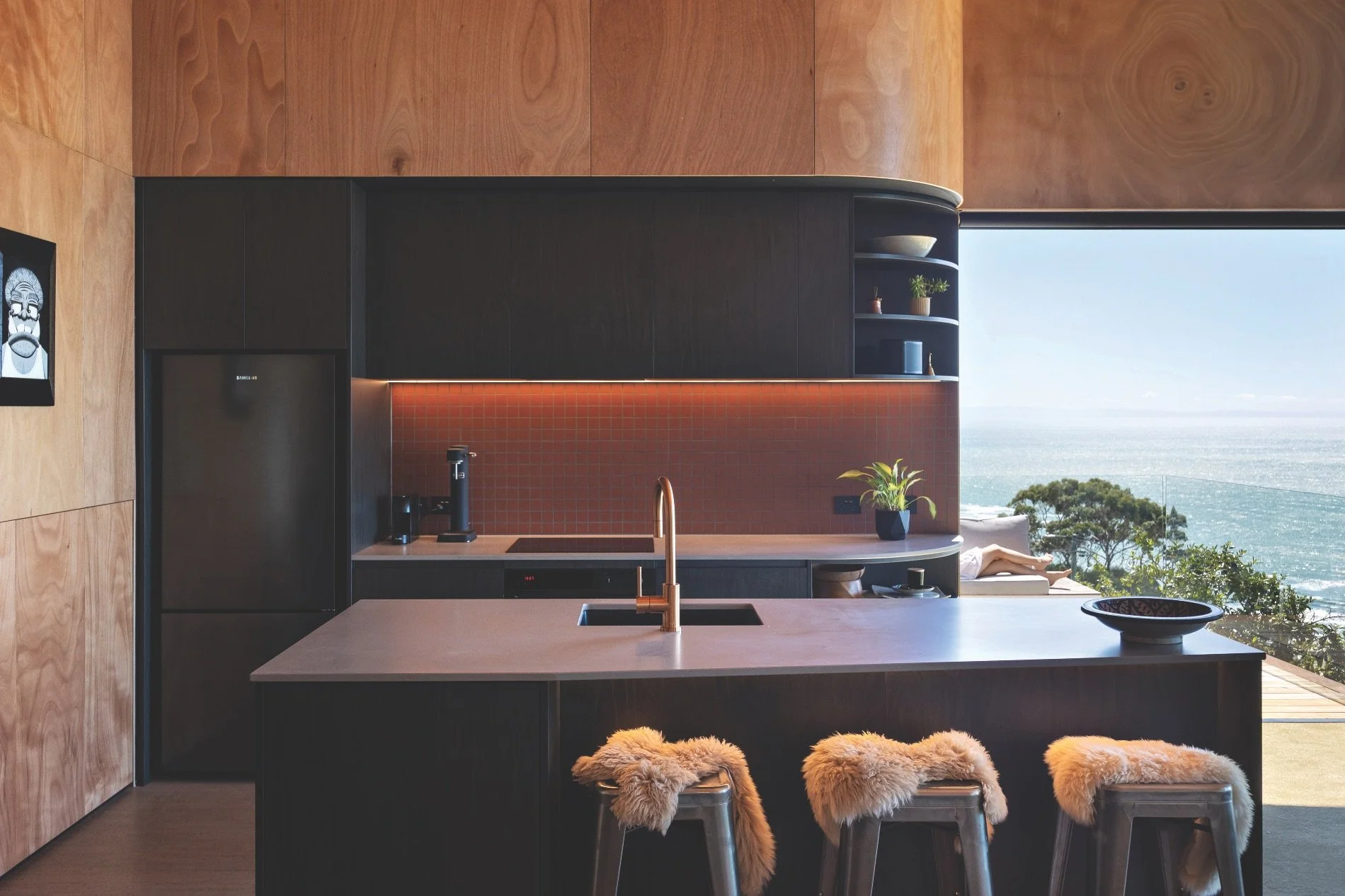
The curved okoume ply wall linings, installed by Podocarp Cabinetry, showcase the meticulous craftsmanship required, which is also reflected in the joinery in the kitchen, vanities, laundry and the saligna handrails.
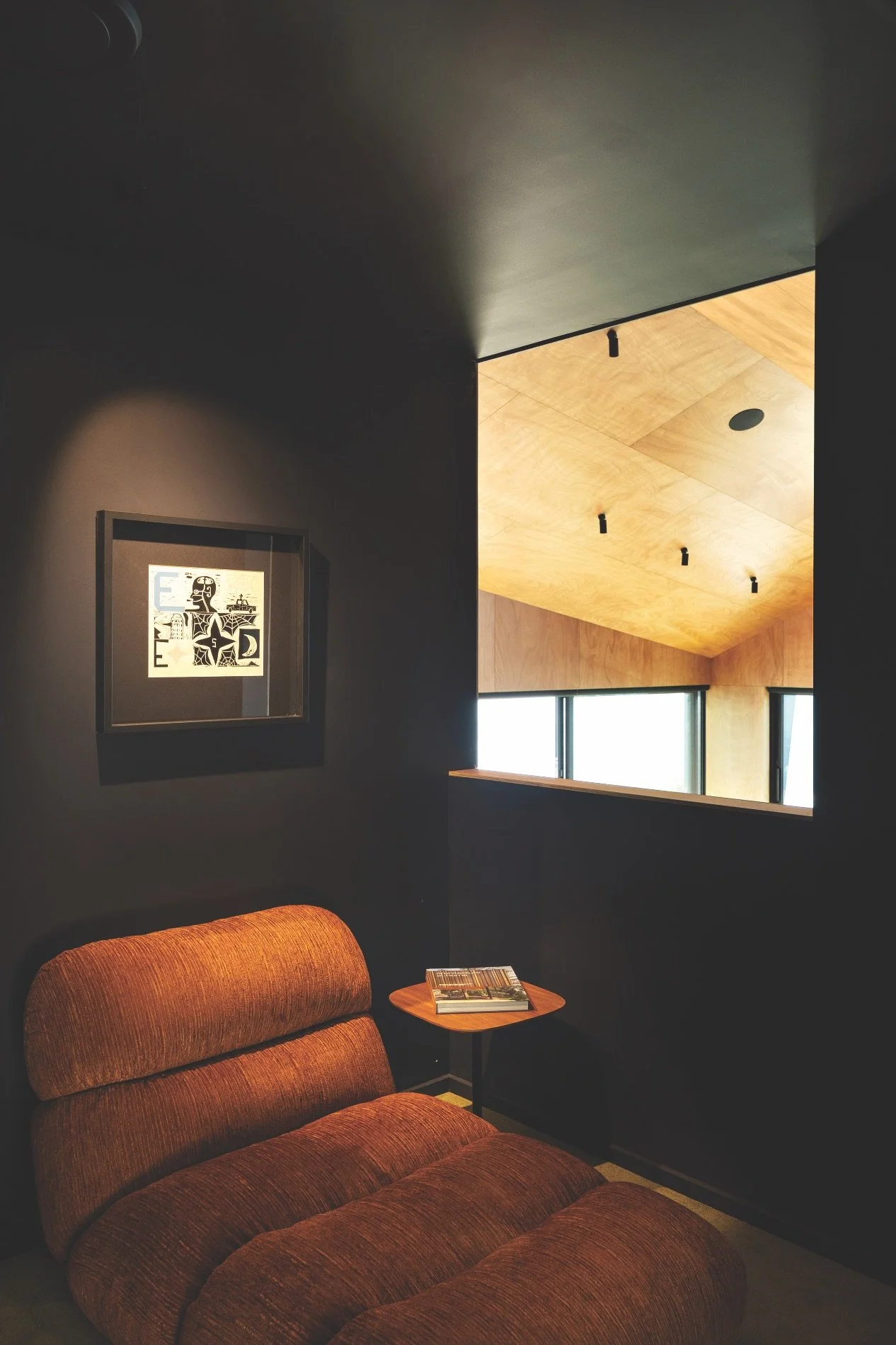
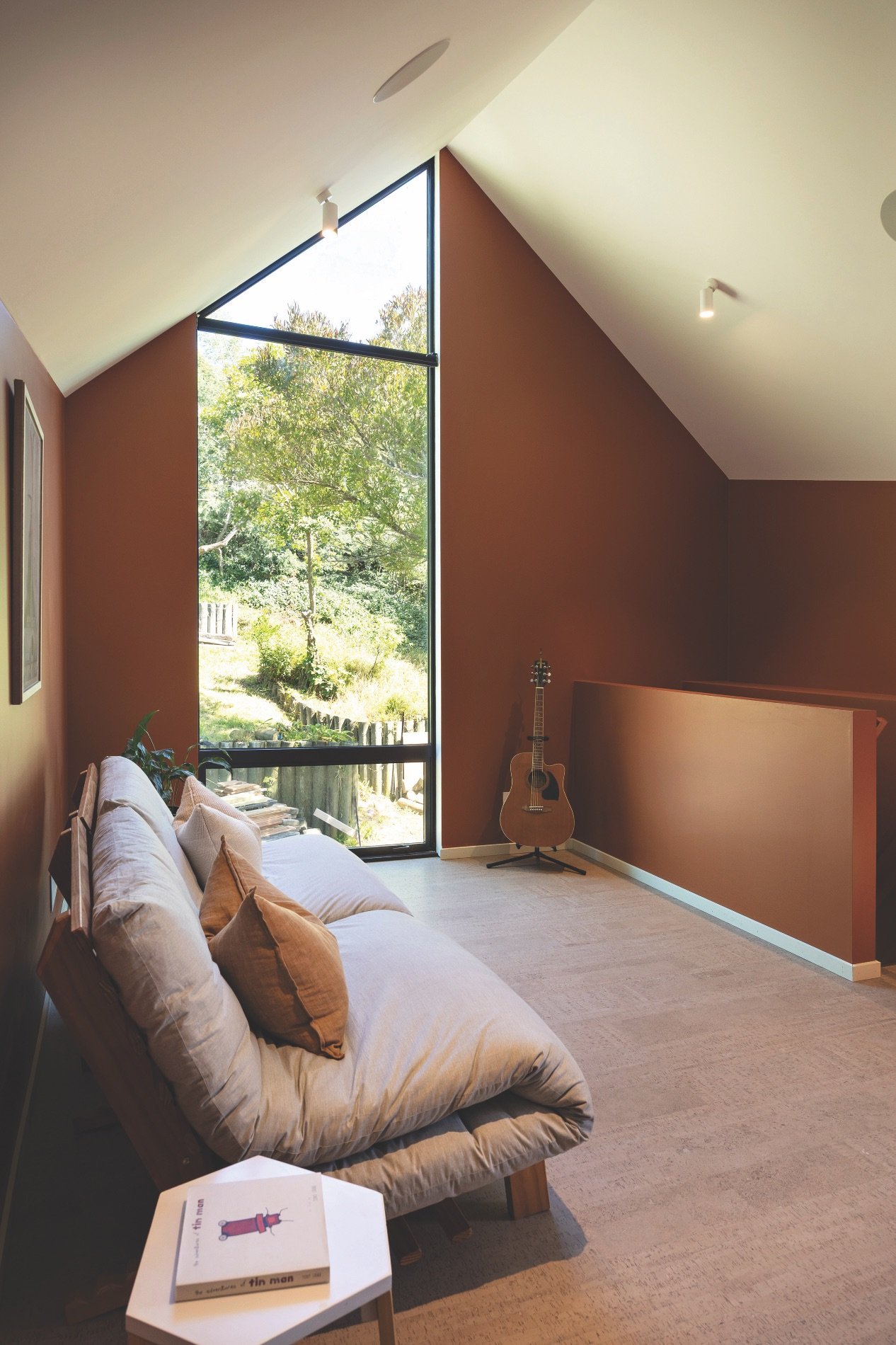
“It feels a lot larger than it is,” explains Aaron. “It’s a two-bedroom house with an open-plan kitchen-living- dining, and it also has two flexi rooms.” A loft at the back of the house works as a studio, gym, yoga space or overflow sleeping area. And on a mezzanine is the music room, a dark and cosy spot for listening to vinyl that also is highly adaptable and could be an office or a bedroom. “It has a square opening that overlooks the living area, so we call that the DJ booth. Kids love to throw paper planes out of there: it’s quite an interactive space.”
This flexibility of the layout means a long life for the house, as it can grow or shrink to accommodate all sorts of living arrangements, from retirees to growing families.
Energy efficiency and building performance are also key. There are high levels of insulation, angled wings and eaves for solar control, and the house generates its own electricity with excess storage to battery, and with Aaron’s current use there are no power bills. Experiencing the financial and logistical aspects of the new build was useful for Aaron. “I think it’s really important to have that understanding of the stress that comes with building a house: what it’s like to have issues that need resolving, and thinking about where you need to prioritise your budget.”
Material selection and construction were approached with long-term durability in mind, particularly given the coastal environment. A restrained palette of timber, steel and blockwork externally, combined with warm interior linings and low-impact materials, supports both performance and longevity. “I wanted simple materials that add a level of detailing to the architecture, but don’t date.”
A standout is the okoume plywood lining the walls, which imparts a warm golden glow. “It’s finished with a little sheen, to protect the natural colours and textures of the timber and so that light bounces around to accentuate the angles and curves. The spaces feel cosy and interesting.”
Here Aaron was hands-on. “I spent two months up scaffolds sanding all that ply and doing three coats. It’s nice to look up and remember every millimetre. It adds a layer of attention and love to your own spaces when you put in the effort like that, but I wouldn’t want to do it again.”
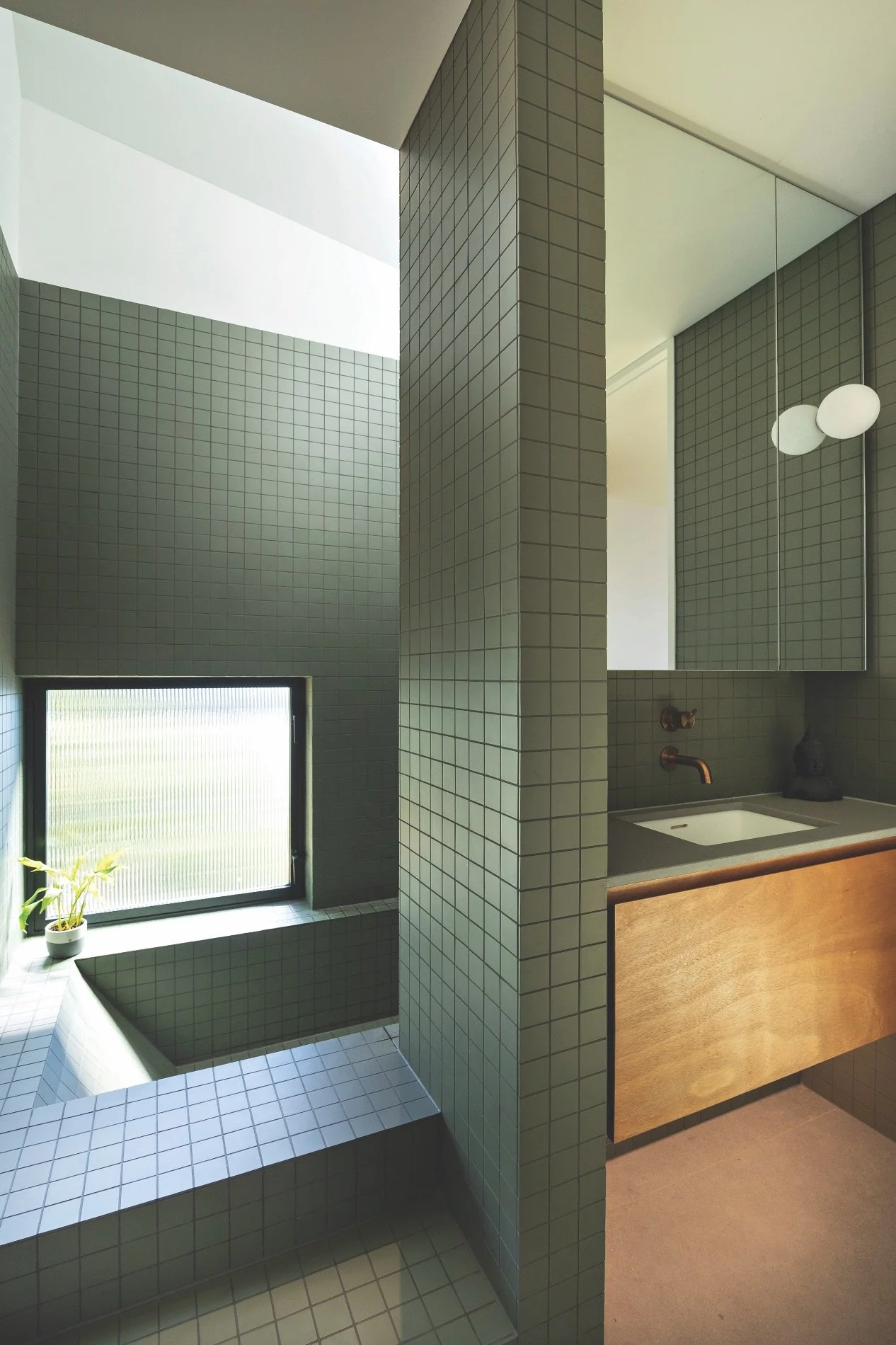
Also a favourite is the simple tile used throughout. All the bathroom, kitchen and laundry spaces exactly align to the dimensions of the 50 x 50mm tiles, each room with its own colourway. In the ensuite, the tiles line an in-built tub inspired by Japanese ofuro, every tile impeccably placed.
The design is about creating architecture that supports real day-to-day living over time, not just initial visual impact. But the stunning aesthetic and high-end craftsmanship can’t be overlooked. Bringing the house to fruition was builder Brad Richards and his talented crew at Brad Richards Building.
He and Aaron have a long working relationship, and that proved invaluable on a project that was anything but straightforward.
“It was a technical hill build,” says Brad. “Narrow road, steep site, and a lot of intricate angles, internally and externally.”
Despite the complexity, the house was completed in just 10 months, thanks to seamless project management and clear communication. Decisions were made quickly, says Brad, and Aaron was on-site most days for on-the-spot evaluation rather than relying on drawings.
“Although it’s not a huge house,” says Brad, “it’s made up for it in the details. It has very high-end, bespoke joinery and fittings throughout. Aaron was amazing to work with and although it was a challenge, it was very rewarding.”
The house unfolds in split levels, stepping with the contour of the land. With a small team of six builders, Brad Richards Building specialises in these kinds of architectural builds and challenging sites. It means an in-depth understanding of the design intent and the nature of the terrain.
“We’ve got a lot of experience building on the hills. It comes with some amazing views, which is a nice environment to work in.”
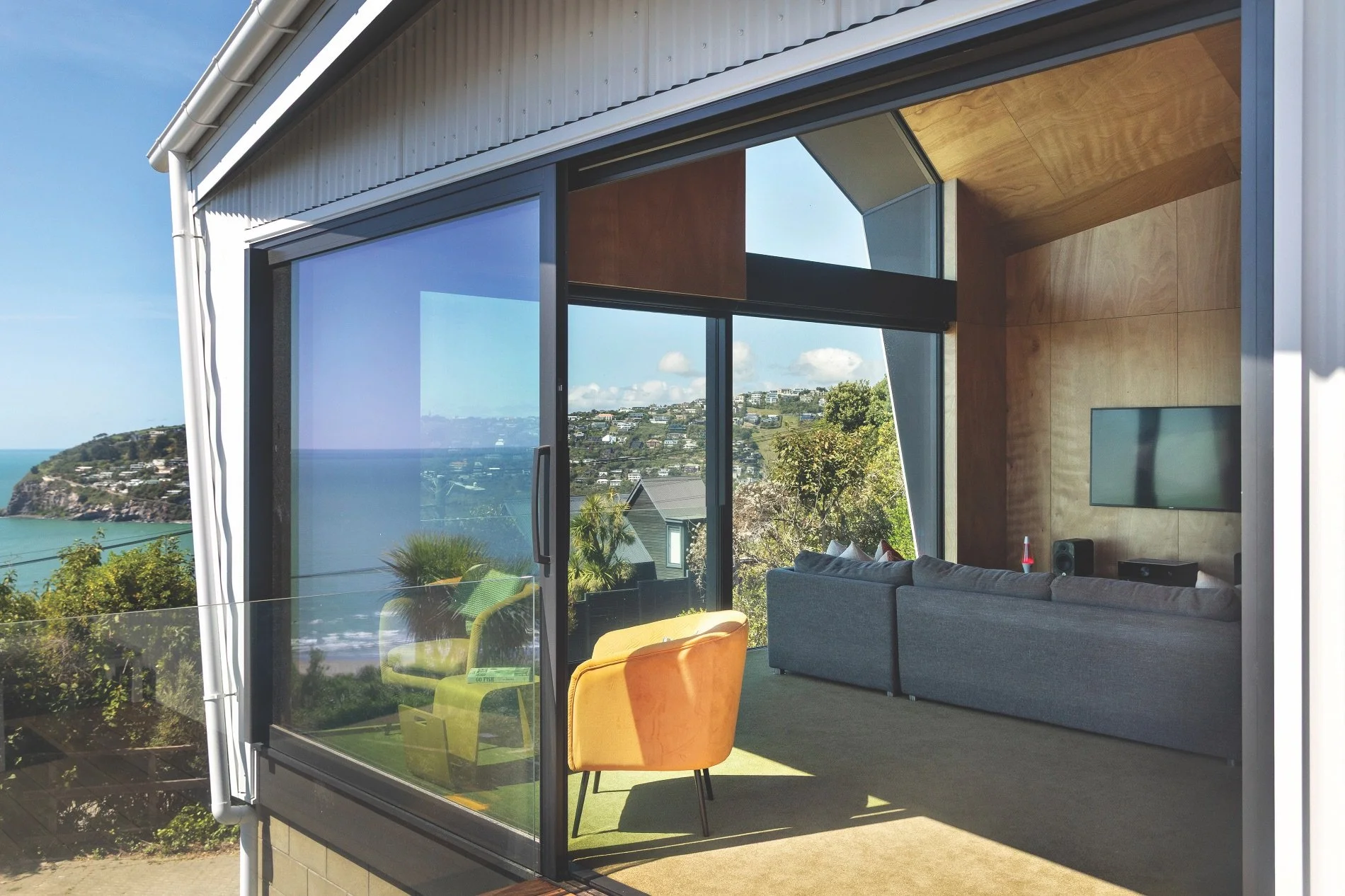
He loves the bespoke feeling of the house. “We’re very proud of what we’ve contributed, and it’s a pleasure standing in that living room with the cathedral ceilings looking out at the views. It’s quite a special spot.”
There’s a Juliet balcony on that gable end, facing northeast, in addition to a deck looking northwest towards the Southern Alps across New Brighton Spit. To Aaron, applying his long-earned knowledge of this environment, the prevailing wind, the angles of the sun, represents a proof of concept.
“A project like this doesn’t happen in isolation,” says Aaron. “It takes a tight, experienced group of builders, subtrades and consultants working together, and I’m hugely appreciative of the team that helped bring it to life. We’re always learning; every job is a new lesson. There’s always something we’re refining with the people we work with, sharing knowledge and applying it to the next project. It’s about being open-minded to always improving, even more so when you’re building your own house.”
Involved in this project
ARCHITECTURAL DESIGNER
Urbanfunction
03 374 6318
urbanfunction.co.nz
BUILDER
Brad Richards Building
03 355 0545
bradrichardsbuilding.co.nz
JOINERY
Podocarp Cabinetry
021 710 392
podocarpcabinetry.co.nz
LIGHTING
Accent Lighting
03 379 0600
accentlighting.co.nz
WINDOWS & DOORS
Rylock Canterbury
0800 795 625
rylock.co.nz
DECKING & CLADDING TIMBER
LMA Timber
027 255 4345
lmatimber.co.nz
PLYWOOD WALL & CEILING LININGS
Plymasters
0800 344 112
plymasters.co.nz
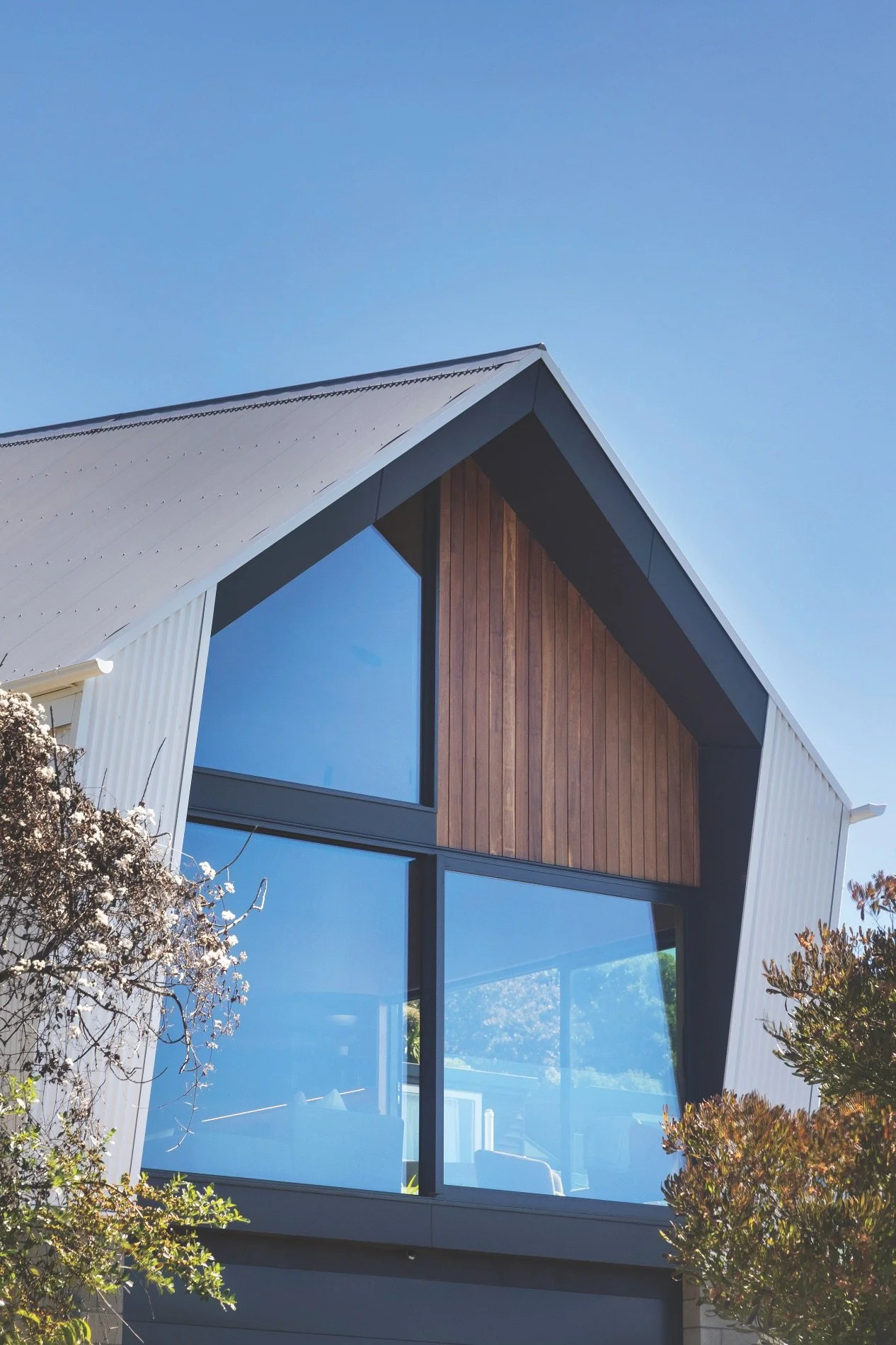
Decking and cladding timber was supplied by LMA Timber, specialists in recycled, reclaimed and sustainably sourced Australian hardwood. Durable materials were a central component of the build’s design approach.